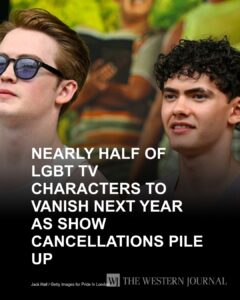
Nearly Half of LGBT TV Characters to Vanish Next Year as Show Cancellations Pile Up
GLAAD’s annual “Where We Are on TV” report offers a clear picture of the state of LGBT representation on television: It’s shrinking.
The group is sounding the alarm after finding that 41 percent of LGBT characters counted this year will not return to screens next season.
The reason is simple. Their shows were canceled, or their characters are leaving the shows.
GLAAD framed the cancellations as something dangerous.
The report described the moment as a “critical juncture” shaped by rising political tensions and what it called “hateful rhetoric.”
It also argued that Hollywood must “double down” on LGBT storylines to counteract the culture.
But the numbers tell a different story.
GLAAD counted 489 LGBT characters across TV this year.
That is a massive jump from the 47 characters recorded in the study’s early years. It is also far higher than the percentage of Americans who actually claim to be LGBT, which remains in the low to middle single digits.
That means self-professed LGBT characters are already dramatically overrepresented on television.
Almost every major prestige drama includes at least one LGBT arc.
Recent hits like “Pluribus,” “The Chair Company,” “The Last of Us,” “Euphoria,” “Bridgerton,” and “Abbott Elementary” all include prominent homosexual characters or storylines.
That means self-professed LGBT characters are already dramatically overrepresented on television.
Almost every major prestige drama includes at least one LGBT arc.
Recent hits like “Pluribus,” “The Chair Company,” “The Last of Us,” “Euphoria,” “Bridgerton,” and “Abbott Elementary” all include prominent homosexual characters or storylines.
GLAAD’s concern about cancellations ignores why so many shows are being cut. Some ran their natural course. Others failed to attract viewers.
And many frustrated audiences are tired of LGBT themes being wedged into scripts that otherwise had nothing to do with sexual orientation.
Hollywood spent years chasing representation goals that far outpaced the real world.
Now the industry is pulling back as streaming costs rise and viewer interest drops. If new shows stop artificially elevating LGBT characters, the representation will likely fall closer in line with demographic reality.
GLAAD tried to stoke fear that this outcome would be harmful.
But viewers are voting with their habits.
Forced storylines feel tired. Predictable arcs feel stale. And audiences can sense when a show is more interested in checking boxes than telling a compelling story.