Father Takes Tough Action After Daughter Bullies Classmate Battling Cancer
No matter how much parents might want to believe that their children are perfect, the reality is far from that ideal. Every child, regardless of upbringing or environment.
Is bound to make mistakes along the way. Childhood is, by its very nature, a steep learning curve, full of trials, errors, and moments of discovery.
This is not a reflection on the love, care, or dedication of most parents—far from it—but rather a fundamental aspect of growing up. The process of learning right from wrong, of understanding social dynamics, and of developing empathy and self-awareness often involves missteps that children may later regret once they fully comprehend the impact of their actions.
What truly matters, then, is not simply the mistakes themselves, but the lessons learned and the growth that follows. Parents, educators, and guardians introduce the concept of consequences precisely for this reason: to create a connection between actions and outcomes, helping children internalize moral and social lessons.

The goal is to guide children toward understanding the real-world implications of their behavior, ideally preventing repetition of the same mistakes. Punishments, in this context, are not intended as arbitrary or cruel measures but as teaching tools designed to reinforce accountability and empathy.
They range from mild interventions, such as a verbal warning or grounding, to more significant and memorable actions that leave a lasting impression on the child’s conscience. One story that has garnered significant attention in recent years falls into the latter category.
It involves a father who took a decidedly unconventional approach to teaching his daughter a lesson about empathy and accountability. The incident in question occurred at school when the daughter was caught mocking another student who had lost all of her hair due to chemotherapy.
Such behavior, while unfortunately not uncommon among teenagers navigating the complex social hierarchy of school, is nonetheless deeply hurtful, particularly when it targets someone already coping with significant personal challenges.
The father, understandably disturbed by his daughter’s lack of compassion, decided that conventional disciplinary methods might not be sufficient to convey the seriousness of the situation. In an effort to teach his daughter a tangible lesson about empathy—specifically, about truly understanding the emotional impact of her actions—he chose to shave her head bald.
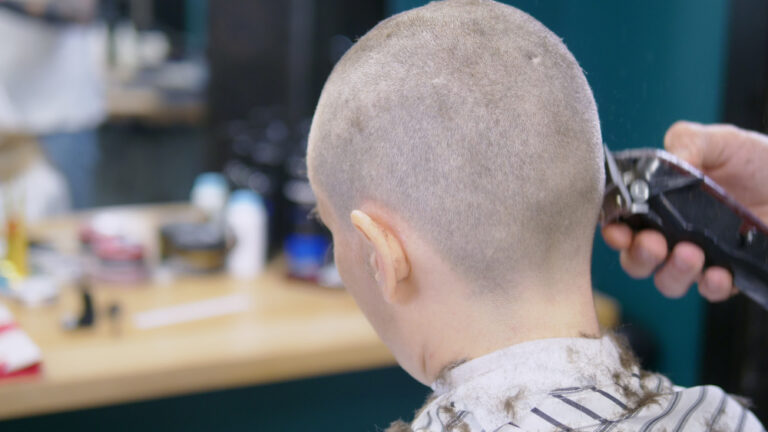
The rationale behind this decision was to give his daughter a literal experience of walking in her victim’s shoes, feeling the vulnerability and exposure that come with hair loss. By doing so, he hoped she would develop a more profound understanding of the consequences of her cruelty and learn to exercise kindness and sensitivity in the future.
The father’s choice, however, has not been without controversy. The incident quickly drew attention online, with many expressing shock or disapproval at the severity of the punishment. Critics argued that physically altering a child’s appearance as a form of discipline crosses boundaries and may be psychologically harmful.
Nevertheless, the father remained resolute, emphasizing that his decision was motivated not by a desire to humiliate but by a commitment to instill empathy, accountability, and moral awareness in his daughter. In interviews with media outlets, he consistently framed the action as a carefully considered response to behavior he deemed inexcusable.
Adding another layer of complexity to the situation, the father revealed that the bullying incident was intertwined with ongoing teenage drama involving romantic relationships. According to his account, his daughter had been dating a boy who was previously involved with the girl she mocked.
Tensions escalated in class when an argument erupted, centering around rumors and accusations that are all too common in high school environments. The father described how the conflict intensified after the other girl insulted his daughter using explicit language and derogatory accusations about her personal life.
While these interpersonal dynamics are typical among adolescents, the response of mocking and targeting another student already facing a serious medical challenge represented a moral boundary the father found unacceptable.
The father explained that his daughter showed no initial remorse and even attempted to justify her behavior by claiming the other girl “deserved” it. This lack of accountability and empathy was the primary motivator behind the decision to implement such a dramatic form of discipline.
He expressed deep disappointment and concern over his daughter’s behavior, noting that it reflected a fundamental deficiency in understanding the experiences and feelings of others. By imposing a punishment that forced his daughter to confront vulnerability firsthand, he aimed to bridge that gap in awareness and foster a more compassionate outlook.
While many people, including the girl’s own mother, criticized the punishment as extreme, the father defended his actions as a proportional and meaningful response to a serious lapse in judgment. He emphasized that the lesson was designed to be both memorable and instructive, ensuring that his daughter would internalize the consequences of her actions in a way that mere verbal reprimands or minor punishments could not achieve.
He expressed deep disappointment and concern over his daughter’s behavior, noting that it reflected a fundamental deficiency in understanding the experiences and feelings of others. By imposing a punishment that forced his daughter to confront vulnerability firsthand, he aimed to bridge that gap in awareness and foster a more compassionate outlook.
While many people, including the girl’s own mother, criticized the punishment as extreme, the father defended his actions as a proportional and meaningful response to a serious lapse in judgment. He emphasized that the lesson was designed to be both memorable and instructive, ensuring that his daughter would internalize the consequences of her actions in a way that mere verbal reprimands or minor punishments could not achieve.